Voice bridge
Programmable Voice Interface for Devices
A lightweight voice terminal built around ESP32-S3 that connects to live AI models and executes functions locally.
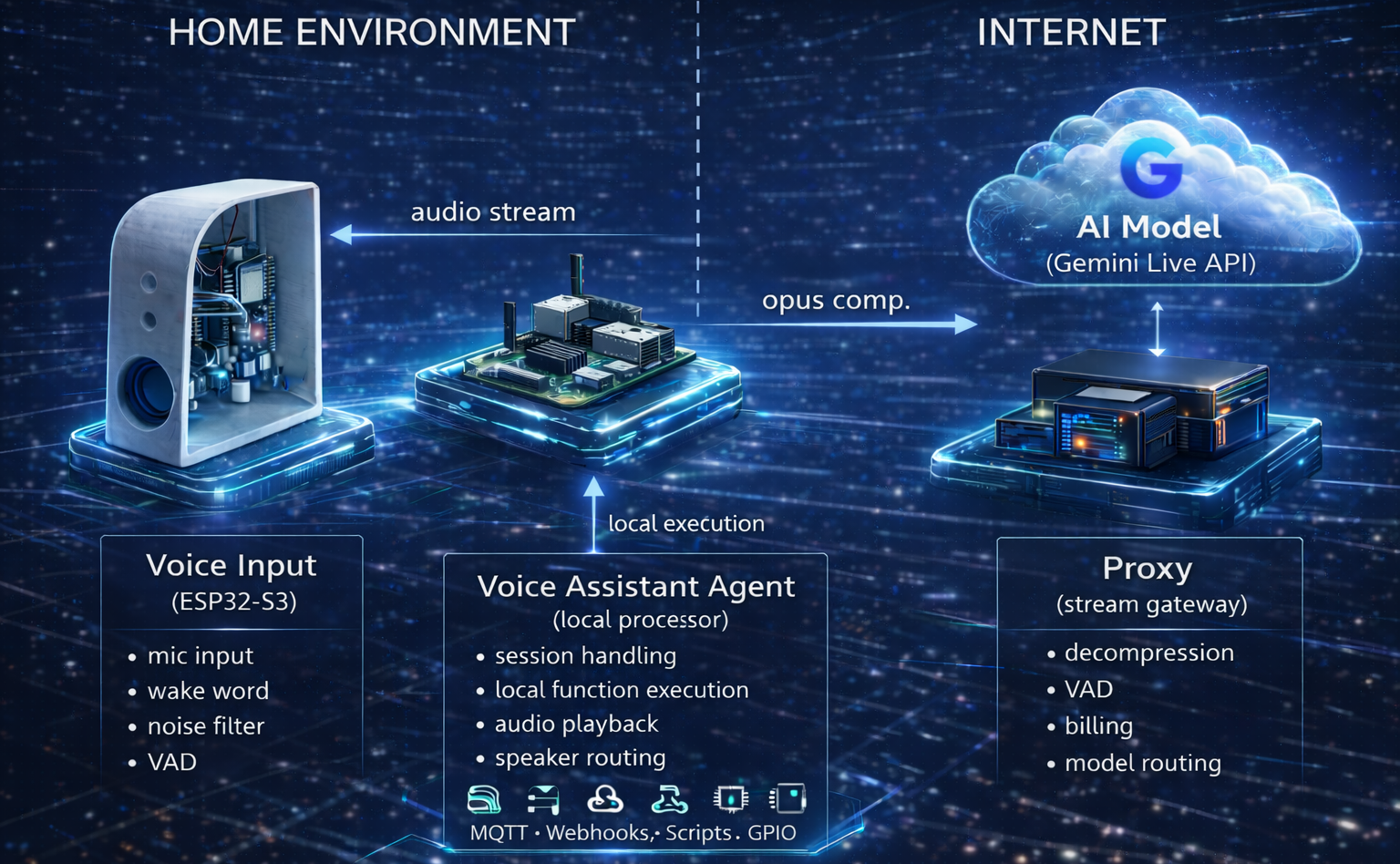
Instead of trying to squeeze a full assistant into a microcontroller, this project separates the system into clear layers:
- ESP32 voice frontend: captures audio, runs the device UI, and detects the wake word.
- Local assistant agent: runs logic and executes functions in your environment.
- AI model integration: adds reasoning, speech understanding, and real-time responses.
This keeps the hardware simple while still enabling powerful voice control over scripts, devices, and automation systems.
Connect an ESP32-S3 to a live AI model and let it:
- answer questions
- search the web
- control devices
- run automations
- execute server commands
- play audio
- generate TTS with voice and emotion control
- MCP integration STDIO, STREAMABLE HTTP
- Up to 90% bandwidth reduction via compression
- AI noise cancellation
- Wake word support for microcontrollers
- MCP server and client
MCP support (client and server)
Added MCP support as client (ext system integration) and server (provide TTS, voice control, etc).
DetailsSystem Architecture
The system is intentionally split into independent components so each layer can focus on a specific task.
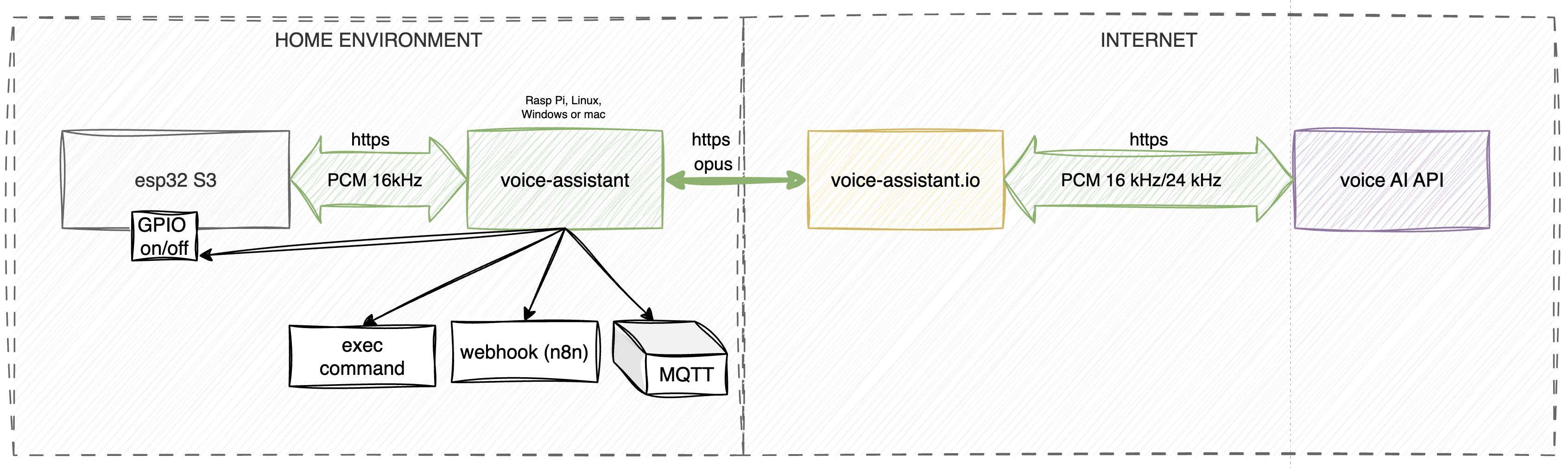
Voice -> Function Execution
Instead of being limited to predefined commands, the assistant uses AI models to determine which function should be executed.
Example flow:
Functions can control almost anything:
- smart home devices
- scripts and CLI tools
- webhooks
- local automation systems
- GPIO hardware
Voice becomes a universal control interface. No firmware updates required when you modify functions in the dashboard. Changes take effect instantly.
DetailsHardware
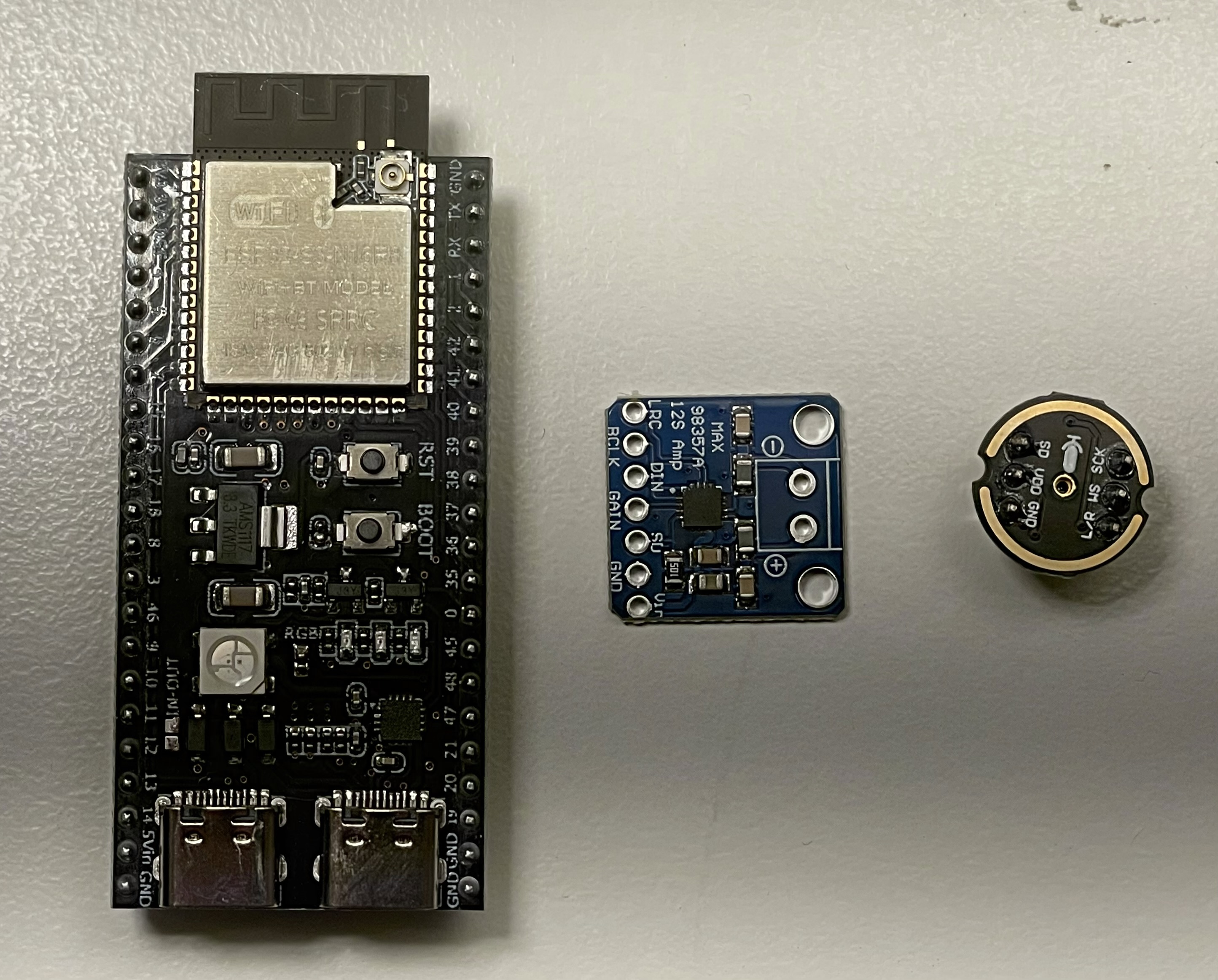
The hardware is intentionally minimal and easy to build.
The repository includes:
- schematics
- PCB design
- ready-to-use Gerber files
- firmwares
- multiplatform scripts
- Nice TUI interface
- You can select Wake word model from the list
This allows anyone to assemble a voice terminal with standard components.
A minimal setup takes about 15-20 minutes. (if your hardware schema is ready)
Flash the ESP32 firmware:
Example Use Cases
The system is designed as a flexible voice interface rather than a fixed assistant.
- Smart Home: Control lights, devices, and automation systems through MQTT or webhooks.
- Developer Tools: Trigger builds, run scripts, or deploy projects by voice.
- Custom Hardware: Add voice control to robotics, lab equipment, or electronics projects.
- Automation Systems: Integrate with workflow engines like n8n or other automation platforms.
Demo
Turn Your Controller into a Voice Interface
Connect devices, execute commands, and integrate external services through one AI layer.